
 English
 Español
 русский
 Français

A mold quote for an aluminum die casting mold can swing by 30–50% for the same nominal part. The difference is rarely t...
READ MORE
Content

Modern telecommunication systems are becoming more powerful, compact, and densely integrated. Fifth-generation communication equipment, outdoor base stations, radio units, power amplifiers, network terminals, and other infrastructure must process increasing amounts of data while operating reliably in demanding environments. As electrical power rises, more heat is generated inside smaller enclosures. If that heat is not removed effectively, component temperatures can exceed design limits, leading to signal instability, shortened service life, reduced energy efficiency, or unexpected equipment failure.
The die casting telecommunication heat sink is designed to address this challenge. Manufactured primarily from aluminum alloy, this component provides an efficient thermal path between heat-generating electronic components and the surrounding air or cooling system. Its integrated fins, mounting surfaces, structural features, and precise interfaces allow it to support both thermal management and mechanical assembly. Through advanced die casting, mold design, precision machining, trimming, and inspection, a well-engineered heat sink can deliver consistent performance in large-scale communication equipment production.
Ningbo Dinghong Mould Co., Ltd. manufactures aluminum alloy die-casting products and die-casting molds for telecommunication, automotive, household appliance, electrical, new-energy, photovoltaic, robotic, and other industries. Its die casting telecommunication heat sink is developed for applications requiring efficient heat dissipation, dimensional consistency, structural reliability, and production scalability. The company combines mold design, mold manufacturing, die casting, finishing, inspection, and trade services within one manufacturing organization.
Communication equipment converts electrical energy into radio-frequency signals, digital information, optical signals, and system-control functions. A portion of the input energy is inevitably transformed into heat. The amount of generated heat increases with transmission power, processing speed, antenna density, computing requirements, and the number of active electronic modules installed in a single enclosure.
Traditional communication products often had sufficient internal space for airflow and relatively moderate heat loads. By contrast, newer 5G systems frequently use compact layouts, high-power radio components, advanced processors, power conversion modules, and multiple antenna channels. These elements may be placed close together to reduce signal losses and minimize equipment size. The resulting heat flux can be concentrated over small areas, making thermal design more demanding than simple enclosure ventilation.
A heat sink provides a controlled path for transferring thermal energy away from the source. Heat first moves from the semiconductor package or power component into the heat sink base. It then spreads through the aluminum body and travels into the fins or other dissipating structures. The increased surface area allows heat to transfer to the surrounding air. Depending on the equipment architecture, the heat sink may also work with fans, natural convection, heat pipes, vapor chambers, cold plates, or liquid-cooling assemblies.
For this reason, a telecommunications heat sink is not merely a metal block with fins. It is a precision-engineered thermal and mechanical component. Its base flatness, fin geometry, mounting-hole position, material composition, surface treatment, and dimensional stability all influence system performance. A small deviation at the mounting interface can increase contact resistance. An improperly formed fin can restrict airflow. A casting defect in a critical region can reduce strength or create a path for corrosion. Consistent manufacturing is therefore essential.
The die casting telecommunication heat sink is an aluminum alloy component developed for communication equipment and related electronic systems. Its design can incorporate a broad base, cooling fins, bosses, mounting holes, locating features, reinforcing ribs, cable or connector clearance areas, and interfaces for additional thermal devices. The final geometry is determined by the customer’s thermal requirements, equipment layout, assembly method, and production volume.
Die casting is particularly suitable for complex heat sink structures because molten aluminum alloy can fill a carefully designed mold cavity and form multiple features in a single operation. Compared with assembling many separate pieces, an integrated die-cast structure can reduce the number of joints, simplify assembly, improve dimensional coordination, and support repeatable production. The process also makes it possible to create customized fin patterns and mechanical features that would be difficult or expensive to produce through conventional machining alone.
The product can be adapted for outdoor 5G base stations, remote radio units, telecommunications cabinets, wireless communication equipment, power supply modules, network devices, industrial communication systems, and other applications where efficient thermal management is required. Depending on the project, secondary processes may include trimming, deburring, CNC machining, surface treatment, cleaning, inspection, and packaging.
| Product Element | Function in the Communication System | Manufacturing Considerations |
|---|---|---|
| Heat sink base | Transfers heat from the electronic component into the aluminum body | Requires suitable flatness, thickness, strength, and thermal contact quality |
| Cooling fins | Increase the surface area available for convection and radiation | Fin spacing, height, draft, thickness, and filling capability must be balanced |
| Mounting bosses and holes | Secure the heat sink to the circuit board, housing, or equipment frame | Position, thread quality, perpendicularity, and local strength are important |
| Locating features | Support accurate assembly and repeatable positioning | Must remain stable through casting, trimming, machining, and coating |
| Reinforcing ribs | Improve stiffness and reduce deformation in larger structures | Rib thickness and junction design should minimize shrinkage and stress |
| Surface finish | Provides corrosion protection and supports appearance or thermal requirements | Preparation, coating uniformity, adhesion, and masking must be controlled |
Aluminum alloys are widely used for heat sinks because they provide a useful combination of thermal conductivity, low density, corrosion resistance, and manufacturability. Aluminum transfers heat considerably more effectively than many common structural materials and is substantially lighter than copper. This balance is valuable in telecommunications equipment, where thermal performance must be achieved without creating excessive weight for wall-mounted, pole-mounted, rooftop, or compact cabinet installations.
The performance of a heat sink depends on the complete thermal design rather than material conductivity alone. A die-cast aluminum heat sink can be designed with a broad thermal base, carefully distributed fins, and integrated contact features. When the component is properly machined and assembled against the heat-generating device, it can support a low-resistance thermal path while also functioning as part of the equipment structure.
Die casting allows the heat sink and its mechanical features to be formed as one integrated component. Mounting bosses, ribs, ledges, recesses, cable clearances, and fin arrays can be incorporated into the mold design. This reduces the need for separate brackets or attached thermal plates and can simplify the customer’s assembly process.
Integrated geometry also improves design coordination. When several features are produced in a common mold cavity, their relative positions are established during the same forming operation. Secondary CNC machining can then be limited to surfaces and holes requiring higher precision. This approach can reduce part count, reduce assembly labor, and make the finished equipment easier to service.
Communication equipment is often installed in locations where weight affects transportation, lifting, mounting, and structural support. Aluminum heat sinks offer a lower-density alternative to copper components while maintaining strong heat-transfer capability. Their lighter weight can contribute to more manageable enclosure designs and may reduce the burden on supporting structures.
Weight reduction must not compromise stiffness or durability. Proper fin layout, rib design, wall thickness, and mounting support are therefore important. A well-designed die-cast part can place material where it provides the greatest thermal and structural value while avoiding unnecessary mass in low-stress areas.
Once the mold has been designed, manufactured, validated, and approved, die casting can produce a high volume of repeatable components. This is especially useful for communication equipment manufacturers that require stable deliveries over extended product programs. Automated or semi-automated trimming and standardized inspection procedures can further improve production consistency.
Die casting is also suitable for projects that begin with moderate quantities and later increase as network deployment expands. The same basic mold strategy can support repeat production while process data, quality records, and inspection standards are maintained. For customers operating across multiple markets, stable manufacturing is important because equipment must meet consistent requirements regardless of destination.
Die-cast aluminum parts can undergo a variety of secondary operations. Critical mounting surfaces can be CNC-machined to achieve the required flatness and hole accuracy. Burrs and excess material can be removed through trimming and deburring. Depending on the application, the product may receive cleaning, shot blasting, anodizing, powder coating, conversion treatment, or another protective finish.
Secondary operations can be specified according to the customer’s actual requirements. Not every surface requires the same tolerance or finish. By identifying functional surfaces during the design stage, manufacturing resources can be concentrated where they affect thermal contact, assembly, sealing, corrosion resistance, or appearance.
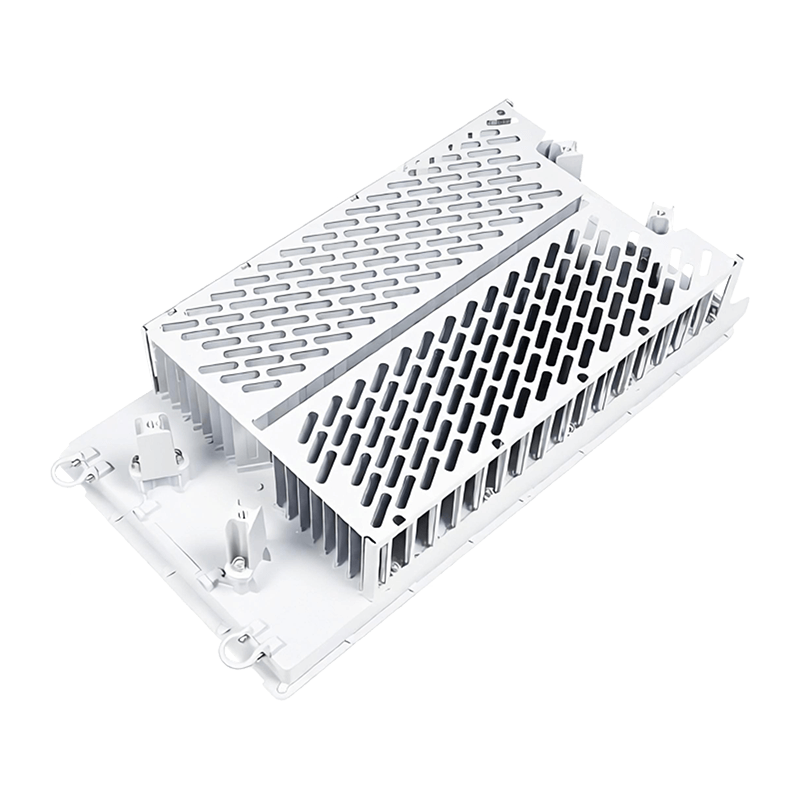
Die Casting Telecommunication Heat Sink
The first design question is how much heat must be dissipated and where that heat is concentrated. A heat sink for a low-power network terminal may have very different requirements from one used with a high-power radio-frequency module or outdoor base-station power amplifier. The design team must consider the component’s maximum heat generation, expected operating cycle, ambient temperature, airflow conditions, enclosure arrangement, and allowable component temperature.
High heat flux requires careful attention to the contact region between the electronic device and heat sink. The base should be sufficiently thick and structurally stable to spread heat away from the source. If the base is too thin or contains unsuitable internal discontinuities, thermal spreading can be reduced. If it is unnecessarily thick, weight and material consumption may increase without proportional performance benefits.
Cooling fins increase surface area, but more fins do not automatically mean better performance. If fins are placed too closely together, airflow may be restricted, particularly in natural-convection applications. If the fins are too widely spaced, the available surface area may be reduced. Fin height, thickness, spacing, orientation, and length must be matched to the expected airflow and available installation space.
Die casting imposes practical design considerations on fin geometry. Very thin or unusually deep features may be difficult to fill consistently and may be more vulnerable to distortion during ejection or trimming. Draft angles are generally required so the casting can be removed from the mold. The mold designer must balance the desired thermal geometry with filling behavior, cooling, release, and long-term mold durability.
The mounting interface is critical because a heat sink must remain in close contact with the heat-generating component. Unevenness, contamination, excessive roughness, or misalignment can increase thermal resistance. Depending on the assembly method, the design may include a machined contact pad, screw holes, threaded bosses, spring-loaded fastener locations, or provisions for thermal interface material.
Fastener locations should provide adequate strength without creating unnecessary stress concentrations. Bosses and ribs may be needed to reinforce areas exposed to clamping loads. The design should also allow tools to reach the fasteners and prevent interference with connectors, cables, shielding components, or adjacent circuit boards.
Telecommunication equipment may operate outdoors or in industrial locations where it is exposed to humidity, dust, temperature changes, salt-containing air, vibration, and repeated thermal cycling. The heat sink must therefore be compatible with the equipment’s environmental protection strategy. Surface treatment, drainage provisions, sealing interfaces, and material selection may all influence long-term durability.
Aluminum naturally forms a protective oxide layer, but additional treatment may be appropriate where the product is exposed to corrosive conditions or must meet a specific appearance requirement. Coating thickness and coverage should be controlled so that protective treatment does not interfere with critical mounting or thermal contact surfaces. Masking plans should be defined before production begins.
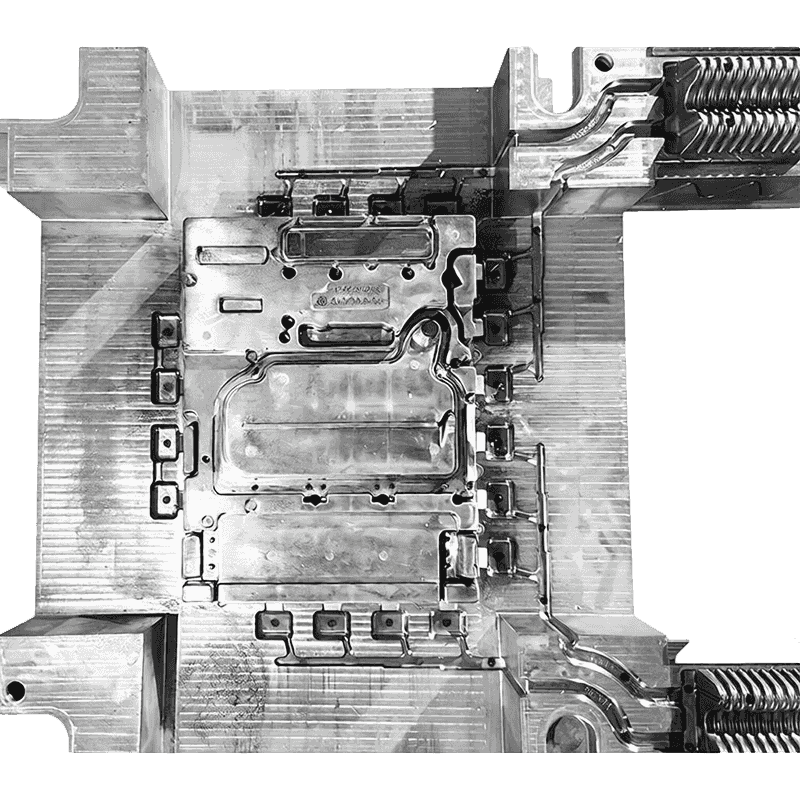
The quality of a die-cast heat sink begins with the mold. A mold must reproduce the customer’s geometry while also supporting stable filling, controlled solidification, efficient ejection, and acceptable cycle times. The design must account for alloy behavior, wall thickness, fin arrangement, draft, shrinkage, parting lines, overflow locations, vents, runners, gates, ejector pins, cooling channels, and access for maintenance.
Ningbo Dinghong Mould Co., Ltd. has experience in mold design and mold manufacturing for aluminum alloy products. Its design team uses advanced software and mold-flow analysis to evaluate proposed designs before production. Mold-flow analysis can help visualize how molten metal fills the cavity, identify potential air entrapment or cold-shut areas, review solidification behavior, and optimize gate and overflow arrangements.
Early analysis is valuable for telecommunications heat sinks because fin arrays and thin structural features can create filling challenges. A design that appears acceptable in a three-dimensional model may still require changes to the gate location, wall transitions, venting, or local thickness. Evaluating these factors before steel is cut can reduce development risk and limit expensive modifications after mold completion.
The mold structure should also be designed for practical production. Ejector pins must be positioned to remove the part without damaging thin fins or delicate bosses. Cooling channels should support balanced thermal conditions in the mold. Replaceable inserts may be used in areas subject to wear or where future design changes are possible. Proper attention to maintenance access can extend mold service life and help maintain dimensional stability during long production runs.
A design-for-manufacturing review connects the customer’s functional goals with the realities of die casting. During this review, the manufacturer can examine wall thickness, transitions, radii, draft, machining allowances, hole requirements, surface-treatment areas, and inspection datums. The purpose is not simply to make the part easier to cast. It is to achieve the required thermal, mechanical, dimensional, and commercial performance with a reliable process.
For example, a sharp internal corner may create stress concentration and hinder metal flow. A small change to the radius can improve filling and reduce the risk of premature solidification. A local wall-thickness adjustment may improve strength or reduce shrinkage. A revised parting line may simplify trimming and protect a critical appearance surface. These changes are most effective when discussed before mold manufacturing.
Production begins with a review of the customer’s three-dimensional model, two-dimensional drawings, technical standards, expected annual quantity, packaging requirements, and application conditions. The manufacturer identifies critical characteristics such as thermal contact flatness, mounting-hole position, fin dimensions, overall envelope, surface treatment, and allowable casting defects.
At this stage, the design team may recommend adjustments based on die-casting capability, machining access, mold construction, or inspection methods. Clear agreement on datums and tolerances helps prevent confusion later. It also establishes a foundation for process planning and quality documentation.
After design approval, engineers develop the mold structure and production drawings. The mold is manufactured using precision machining, CNC equipment, electrical discharge machining, grinding, and other suitable operations. The accuracy of the mold directly affects the repeatability of the castings, especially in areas involving fin pitch, mounting positions, and enclosure interfaces.
Mold components are inspected during manufacturing and assembled for trial evaluation. Any necessary corrections are recorded and controlled. A trial process allows the team to verify filling, ejection, trimming, dimensional results, and surface condition before formal mass production.
Aluminum alloy ingots and approved recycled material are prepared according to the defined material specification. The alloy is melted under controlled conditions, and attention is given to temperature, cleanliness, composition, and handling time. Proper material preparation supports stable mechanical and thermal performance.
Impurities, excessive oxide formation, and unsuitable temperature control can affect casting quality. For this reason, melting and holding practices should be standardized. Where required by the project, material records and batch identification can be maintained for traceability.
During high-pressure die casting, molten aluminum alloy is injected into the closed mold at controlled speed and pressure. The process is designed to fill the cavity rapidly and reproduce the integrated fin and structural geometry. After solidification, the mold opens and the casting is removed by the ejection system.
Key process parameters may include metal temperature, die temperature, injection speed, intensification pressure, filling time, and cooling conditions. These parameters must be balanced to achieve complete filling while limiting porosity, flash, distortion, and premature die wear. Stable machine settings and regular monitoring are important for maintaining consistent results across production lots.
After casting, runners, overflows, gates, flash, and other excess material are removed. Dinghong’s production capabilities include automated trimming lines and related finishing resources. Trimming fixtures should support the casting accurately and protect important fins, bosses, and reference surfaces.
Deburring is especially important for communication equipment because sharp edges may interfere with assembly, damage cables, or create handling risks. The level of deburring should be defined according to the customer’s requirements. Critical interfaces may receive additional finishing or machining to achieve the required dimensional condition.
Although die casting forms most of the product geometry, selected surfaces may require CNC machining. Typical operations include milling the thermal contact pad, drilling or reaming mounting holes, tapping threads, machining locating surfaces, and removing material from sealing interfaces.
High-precision CNC machining centers allow these operations to be performed according to controlled programs and defined datums. Machining strategies should avoid unnecessary removal of material and should maintain adequate support for thin or finned areas. Fixtures must locate the casting consistently so that machined features remain aligned with the original die-cast geometry.
Surface treatment is selected according to the operating environment, appearance requirements, electrical considerations, and corrosion-protection needs. Possible treatments may include cleaning, conversion treatment, powder coating, anodizing, or other customer-approved processes. Surfaces intended for thermal contact, grounding, or precision assembly may need masking or controlled treatment thickness.
Before treatment, the part should be free from oil, loose particles, and excessive flash. After treatment, the coating or finish should be examined for uniformity, adhesion, coverage, color consistency where relevant, and damage caused by handling. Thorough cleaning is also important for preventing contamination during final assembly.
Inspection is performed throughout the process rather than only at the end. Incoming material, mold components, first-off castings, machined dimensions, surface treatment, and final packaging can all be subject to defined checks. Inspection equipment may include calipers, micrometers, gauges, height gauges, coordinate-measuring equipment, surface instruments, and visual inspection tools.
Typical inspection items for a die-cast telecommunication heat sink include overall dimensions, fin height and spacing, base flatness, mounting-hole position, thread condition, surface defects, burrs, flash, coating coverage, and identification marks. The exact inspection plan depends on the customer’s drawing and quality agreement.
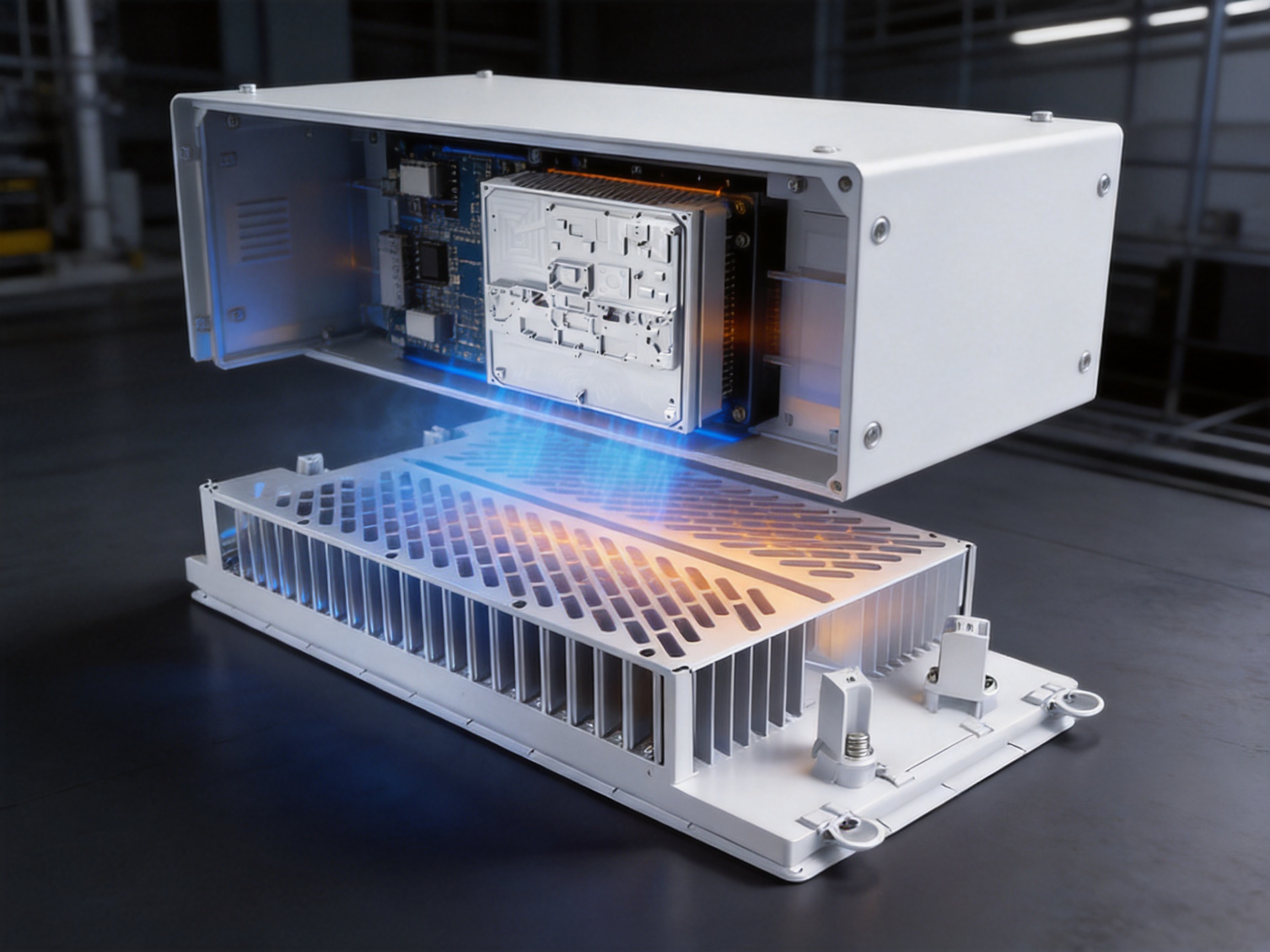
Ningbo Dinghong Mould Co., Ltd. was established in 2013, following the establishment of Yuejin Mould in 1998. The company is located in Daqi Street, Beilun District, Ningbo, Zhejiang Province, near Beilun Port. Its facility occupies approximately 15,000 square meters of plant space and includes mold manufacturing, die casting, machining, finishing, inspection, and related production activities.
The company holds ISO 9001 and IATF 16949 quality management system certifications. These certifications reflect the use of documented management practices, controlled processes, corrective-action systems, and continuous improvement activities. IATF 16949 is particularly relevant to manufacturers serving demanding industrial and automotive supply chains, where traceability, process discipline, and defect prevention are important.
Dinghong’s equipment and production resources include high-precision CNC machining centers, EDM equipment, die-casting machines, automated trimming lines, and testing equipment. The combination of these resources allows the company to manage multiple stages of production and coordinate mold development with die-casting production. This can simplify communication and improve control over product changes.
The company’s experience extends beyond communication parts. It manufactures automotive parts, household appliance components, aluminum alloy products, and components for new-energy, photovoltaic, electrical, motorcycle, pump and valve, fitness equipment, robotic, and other industries. Exposure to different industries supports practical knowledge of casting behavior, structural design, tooling, machining, and quality control.
Customers often benefit when mold design, mold production, casting, machining, and finishing are coordinated by one supplier. An integrated manufacturing process can reduce the number of handoffs, make technical discussions more direct, and allow design changes to be evaluated with knowledge of the entire process. It can also improve responsibility management because the supplier can track a problem from the final product back to the mold or process stage.
For a telecommunications heat sink, this integration is useful when the customer needs a change in fin design, mounting location, surface treatment, or machining tolerance. The mold team can assess the tooling impact, the casting team can evaluate filling and cycle considerations, and the machining team can confirm fixture access and production capability. This coordinated review helps support efficient product development.
A capable engineering team is essential for complex aluminum alloy components. Dinghong uses advanced software and mold-flow analysis to support product development. Digital analysis allows engineers to examine design alternatives before committing to production tooling. It can help identify possible air entrapment, incomplete filling, uneven cooling, and other risks.
Digital tools do not replace practical trial production and inspection. Instead, they improve the starting point for mold construction and help the team make better-informed decisions. The most reliable process combines simulation, engineering experience, trial data, measurement results, and controlled corrective action.
Machining a complete heat sink from an aluminum block can provide excellent dimensional control, but it may involve substantial material removal, long cycle times, high tool consumption, and increased cost for complex fin arrays. Die casting forms much of the required geometry in one operation, reducing waste and improving production efficiency for suitable volumes.
Machined heat sinks may still be appropriate for prototypes, very low-volume projects, or designs requiring exceptionally specialized geometry. However, once the product enters regular production, die casting can provide a more competitive balance between performance, cost, repeatability, and delivery capacity.
Extrusion is effective for constant cross-sectional profiles and can provide good thermal performance. Its limitations arise when the heat sink requires changing fin patterns, integrated bosses, nonuniform bases, angled features, recessed areas, or three-dimensional mounting structures. Additional machining and assembly may be necessary to achieve the final configuration.
Die casting is more flexible for complex three-dimensional shapes. It can integrate several features into one body and may reduce secondary assembly. This flexibility is useful in 5G equipment, where heat sinks often need to fit within irregular enclosures and coordinate with connectors, shielding, boards, and structural frames.
Copper offers high thermal conductivity, but it has a much higher density than aluminum and may increase equipment weight. Copper components can also be more expensive and may require different manufacturing approaches. Aluminum die casting offers a practical alternative when the required thermal performance can be achieved with a lighter and more manufacturable material.
The correct choice depends on heat load, geometry, installation conditions, cost, and system-level thermal design. In many telecommunication applications, aluminum provides a strong overall balance rather than maximizing one material property in isolation.
A multi-part assembly may combine plates, fins, brackets, and fasteners. Although this approach can provide design flexibility, it introduces interfaces that may increase thermal resistance and assembly complexity. More parts also mean more opportunities for misalignment, loosened fasteners, corrosion at joints, or variation during assembly.
An integrated die-cast heat sink can reduce these risks by combining thermal and structural functions in a single component. Where additional vapor-chamber or liquid-cooling technology is required, the die-cast body can still be designed to accommodate the required interface.
As equipment power density continues to increase, conventional air cooling may not be sufficient in every application. Phase-change heat transfer devices, including vapor chambers, can spread heat from a concentrated source across a larger area before it reaches the fin structure. Liquid-cooling systems can remove heat more aggressively through a coolant flowing across or through a dedicated cold plate.
A die-cast aluminum heat sink can be designed as part of a broader thermal architecture. It may provide a support structure for a vapor chamber, a housing for a cold plate, or a finned section connected to another heat-transfer device. The exact design depends on the application and must account for sealing, corrosion compatibility, flatness, joining method, and thermal interface requirements.
Advanced cooling technology does not eliminate the need for accurate manufacturing. In fact, it may increase the importance of dimensional control because the heat sink must connect reliably with other thermal components. Mold-flow analysis, precision machining, inspection, and process control remain essential.
| Application | Typical Thermal Challenge | Heat Sink Contribution |
|---|---|---|
| 5G base stations | High radio power and continuous outdoor operation | Transfers heat from radio and power modules to a finned external or internal surface |
| Remote radio units | Compact packaging near antennas and limited installation space | Combines cooling surfaces with mounting and enclosure functions |
| Communication power supplies | Heat from converters, switches, and power semiconductors | Provides a stable thermal contact surface and increased dissipation area |
| Network terminals | Small enclosures and restricted natural airflow | Supports lightweight, compact, and customized cooling designs |
| Industrial communication equipment | Dust, vibration, temperature variation, and long operating cycles | Provides durable thermal management and mechanical support |
| Wireless infrastructure cabinets | Multiple modules operating in a confined enclosure | Helps organize and distribute heat through integrated structural features |
When selecting a supplier for a die-cast telecommunication heat sink, customers should provide more than a basic external drawing. Useful project information includes the heat source and estimated heat load, allowable component temperature, ambient conditions, airflow direction, enclosure restrictions, mounting method, annual quantity, surface-treatment expectations, and applicable standards.
The customer should also identify critical dimensions and functional surfaces. For example, the thermal contact pad may require a tighter flatness tolerance than an external decorative surface. Mounting holes may require precise positional accuracy, while nonfunctional casting surfaces may use a more general tolerance. Separating critical and noncritical requirements helps ensure that the product is both technically suitable and commercially efficient.
Prototype requirements should be discussed at the beginning. Some projects may require rapid samples for thermal testing before the final mold is completed. Others may move directly into production tooling. A supplier with mold, die-casting, CNC, and inspection capabilities can help determine the most practical development route.
Packaging is also important. Fins and bosses may be vulnerable to impact during transport, and surface treatments can be scratched if parts move against one another. Suitable separators, protective films, trays, cartons, or customized containers should be considered according to the product’s geometry and shipping distance.
Telecommunication equipment is often expected to operate continuously for many years. The heat sink must maintain its thermal and mechanical functions throughout repeated heating and cooling cycles. Thermal expansion, fastener loading, vibration, corrosion, and environmental contamination can gradually affect performance if the design is not robust.
Good manufacturing quality contributes to reliability by controlling defects that could become failure points. Consistent material preparation, stable die-casting parameters, effective trimming, accurate machining, appropriate surface treatment, and documented inspection all support long-term performance. Reliability also depends on the customer’s assembly process, thermal interface material, fastener torque, enclosure sealing, and system-level design.
A well-designed heat sink should therefore be evaluated as part of the complete equipment. Laboratory thermal testing, environmental testing, vibration testing, salt-spray testing, or other validation may be appropriate depending on the application. The supplier can support this process by providing controlled samples, dimensional records, material information, and production documentation.
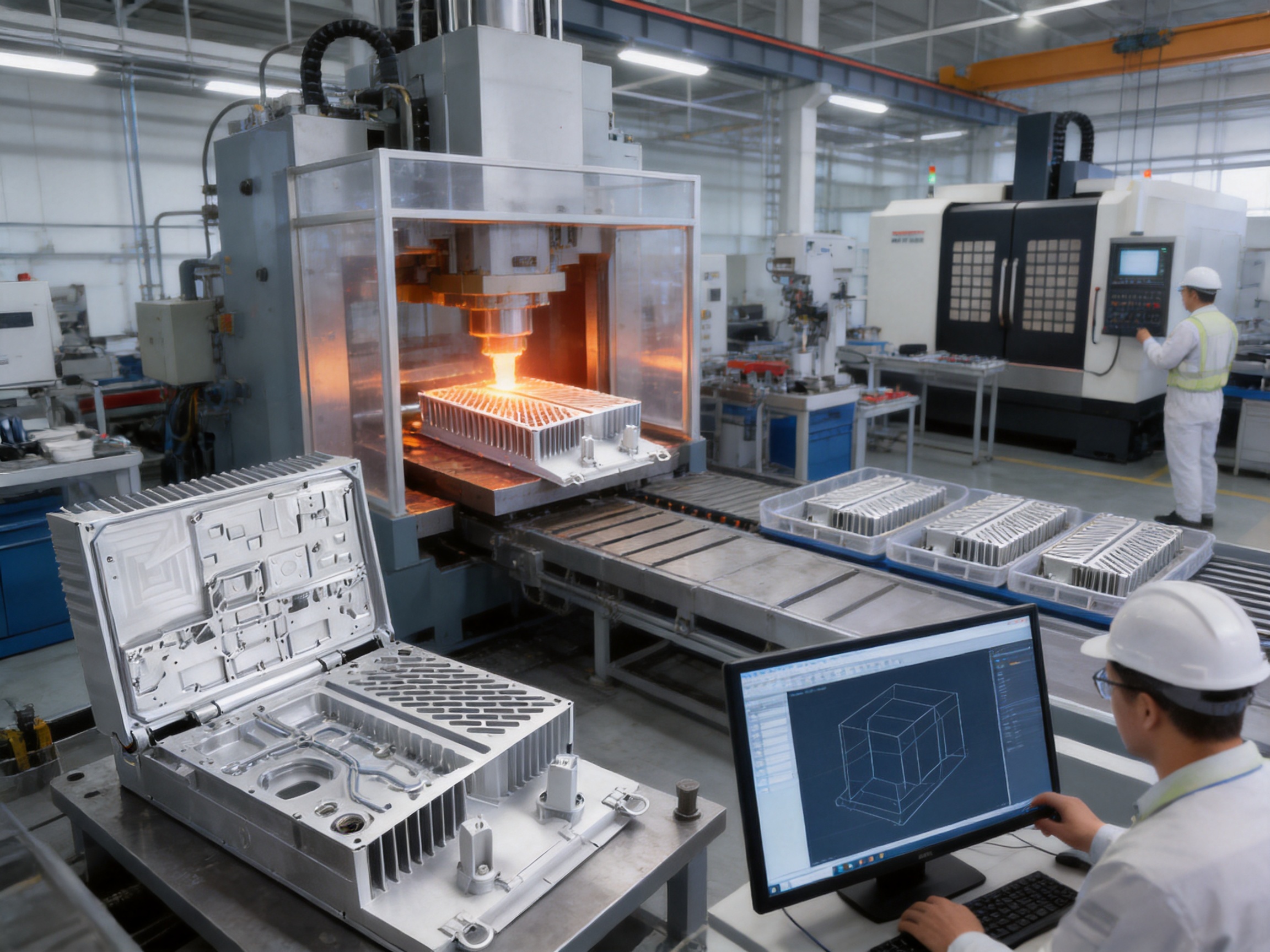
It is an aluminum alloy thermal-management component produced through a die-casting process for communication equipment. It normally includes a heat-transfer base, fins, mounting features, and other geometry required to remove heat from electronic or radio-frequency components.
Aluminum provides a practical combination of thermal conductivity, low density, corrosion resistance, and manufacturing flexibility. It is lighter than copper and can be die-cast into complex shapes, making it suitable for compact and weight-sensitive telecommunication equipment.
Yes. The fin arrangement, base size, mounting holes, bosses, ribs, locating features, machining areas, surface treatment, and packaging can be developed according to the customer’s equipment and performance requirements.
Useful information includes a three-dimensional model or drawing, alloy requirements, annual quantity, target application, thermal load, critical tolerances, surface-treatment specifications, inspection requirements, and packaging expectations. Information about the equipment’s operating environment is also helpful.
Die casting can provide repeatable near-net-shape geometry, while selected surfaces and holes can be finished by CNC machining. The combination is suitable for many communication applications. Required tolerances should be reviewed during design so that the mold, casting process, machining fixtures, and inspection plan are coordinated.
It can be designed to support or integrate with additional thermal technologies. The interfaces must be carefully specified for flatness, sealing, joining, corrosion compatibility, and assembly. The final architecture should be evaluated according to the system’s heat load and operating conditions.
Depending on the application, possible treatments include cleaning, conversion treatment, anodizing, powder coating, or other approved protective finishes. The appropriate treatment depends on corrosion exposure, appearance, electrical grounding, thermal contact, and customer specifications.
Mold-flow analysis helps engineers evaluate filling behavior, potential air entrapment, solidification, gate placement, overflow design, and other process risks before mold manufacturing. It supports better decisions during product and tooling development, although trial casting and physical inspection remain necessary.
Ningbo Dinghong Mould Co., Ltd. has obtained ISO 9001 and IATF 16949 quality management system certifications. Its manufacturing resources include CNC machining centers, EDM equipment, die-casting machines, automated trimming lines, and testing equipment.
The primary applications include 5G base stations, remote radio units, communication power supplies, network terminals, and other telecommunication equipment. Similar thermal and structural components may also be used in electrical, automotive, new-energy, photovoltaic, industrial, robotic, and household appliance products.
The die casting telecommunication heat sink is an important component in the thermal design of modern 5G infrastructure and communication equipment. As power density increases and equipment becomes more compact, manufacturers require cooling components that combine efficient heat transfer, low weight, complex geometry, structural strength, corrosion resistance, and stable production quality.
Die-cast aluminum provides a strong balance of these requirements. It enables the production of integrated fin structures, mounting features, ribs, bosses, and enclosure interfaces while supporting scalable manufacturing. Compared with fully machined, extruded, copper, or multi-part alternatives, it can offer advantages in design flexibility, weight, production efficiency, assembly simplicity, and cost control when properly designed.
The quality of the final product depends on more than the casting machine. Mold engineering, flow analysis, alloy preparation, die-casting parameter control, trimming, CNC machining, surface treatment, inspection, packaging, and customer assembly must all work together. Ningbo Dinghong Mould Co., Ltd. supports this process through integrated mold design, mold manufacturing, die casting, finishing, trade services, advanced equipment, quality certifications, and experience across multiple industrial sectors.
For customers developing 5G base stations, telecommunication cabinets, radio units, network devices, or related electronic products, early cooperation with an experienced die-casting manufacturer can improve both thermal performance and manufacturing efficiency. A carefully engineered heat sink can help protect sensitive components, extend equipment service life, simplify assembly, and support reliable operation in demanding communication environments.
1. Aluminum Association. Aluminum Standards and Data: Material Properties, Alloy Designations, and Manufacturing Guidance.
2. International Organization for Standardization. ISO 9001: Quality Management Systems—Requirements.
3. International Automotive Task Force. IATF 16949: Quality Management System Requirements for Automotive Production and Relevant Service Parts Organizations.
4. American Foundry Society. Engineering Principles of High-Pressure Die Casting and Aluminum Alloy Casting.
5. Dally, J. W., and Riley, W. F. Experimental Stress Analysis and Engineering Design Principles.
6. Incropera, F. P., and DeWitt, D. P. Fundamentals of Heat and Mass Transfer.
7. Çengel, Y. A., and Ghajar, A. J. Heat and Mass Transfer: Fundamentals and Applications.
8. ASM International. ASM Handbook: Properties and Selection of Nonferrous Alloys and Special-Purpose Materials.
9. European Aluminium. Technical Guidance on Aluminum Alloy Processing, Corrosion Protection, and Product Design.
10. Industry technical documentation concerning thermal management, vapor-chamber cooling, liquid cooling, and heat-sink design for telecommunications equipment.

A mold quote for an aluminum die casting mold can swing by 30–50% for the same nominal part. The difference is rarely t...
READ MOREMetal Injection Molding vs Die Casting: Start With the Part A buyer often arrives at this comparison with two very diff...
READ MOREMaterials & Manufacturing Yes, Aluminum Die Casting Parts are consistently lighter than Cast Iron Parts when engin...
READ MOREA 12-week die casting mold build can look competitive on quote and still become the expensive option if the first trial...
READ MORE

Sun Yuejun: +86-13806631860
Wang Shiyong: +86-15958891460 / 15058297768
Dove Yao: +86-18625086675


Copyright © Ningbo Dinghong Mould Co., Ltd. Rights Reserved. Custom Precision Die Casting Aluminum Alloy Parts Manufacturers
