
 English
 Español
 русский
 Français

Materials & Manufacturing Yes, Aluminum Die Casting Parts are consistently lighter than Cast Iron Parts when engin...
READ MORE
Content
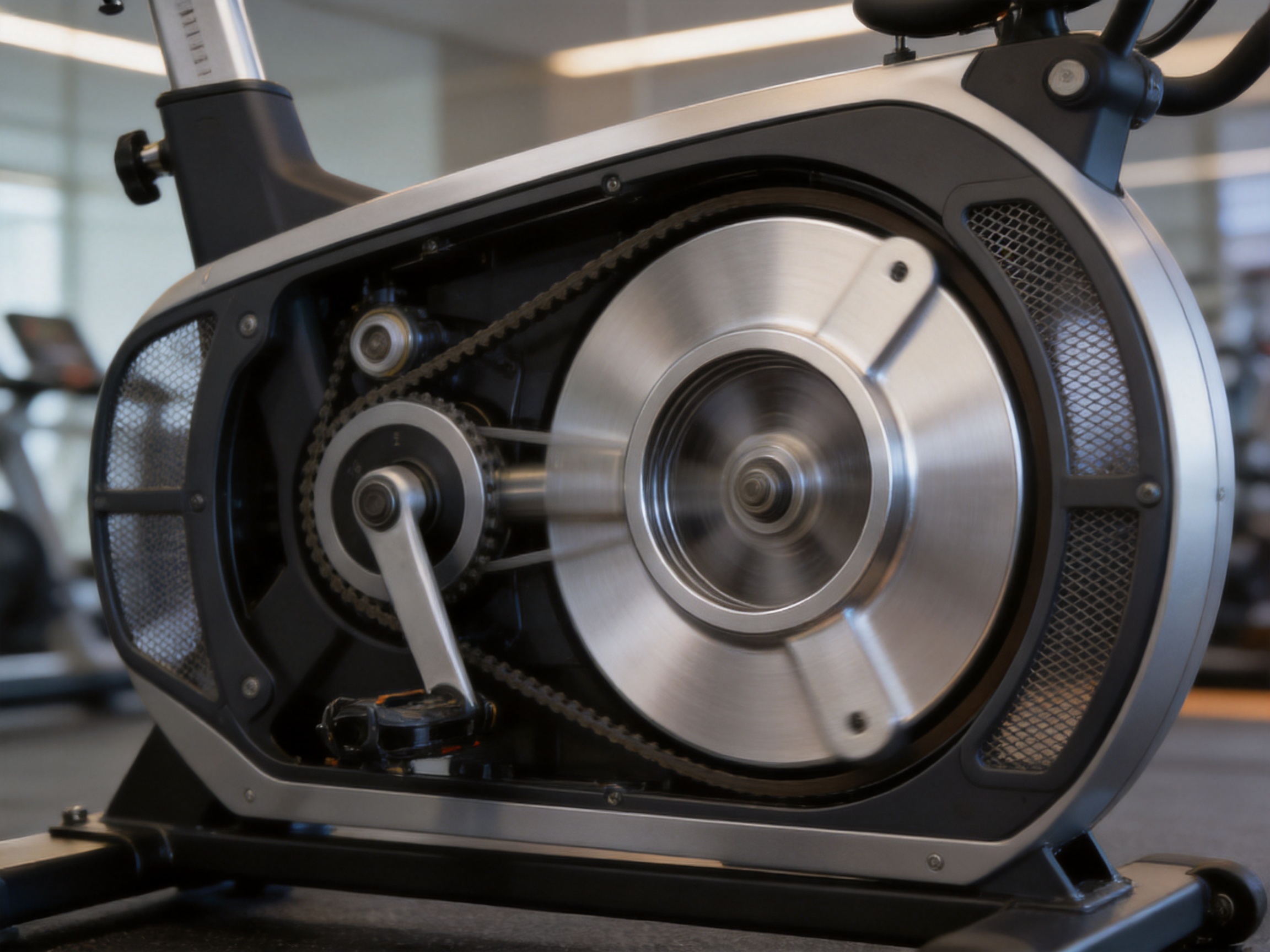
A flywheel is one of the most important mechanical components in many types of fitness equipment. It stores rotational energy, supports smooth movement, contributes to resistance control, and directly influences the user’s perception of quality during every workout. Whether installed in an indoor cycling bike, rowing machine, elliptical trainer, resistance system, or other exercise apparatus, the flywheel must maintain stable rotation under repeated loading. It must also provide the correct balance between mass, inertia, dimensional accuracy, structural strength, appearance, and production cost.
The die casting fitness part flywheel supplied by Ningbo Dinghong Mould Co., Ltd. is developed for manufacturers that require dependable, repeatable, and efficiently produced aluminum alloy fitness equipment components. Through mold design, precision die casting, automated trimming, machining, finishing, and inspection, the company provides a manufacturing route that supports both prototype development and stable mass production. The result is a component designed to integrate into modern fitness equipment while meeting the practical demands of frequent, high-intensity use.
Compared with less controlled manufacturing methods, precision die casting provides a strong combination of production efficiency, shape flexibility, surface quality, and dimensional consistency. It allows complex external features, mounting structures, ribs, bosses, and other functional details to be formed in a single mold cycle. This reduces the number of secondary operations required and helps manufacturers maintain consistent product performance across large production batches.
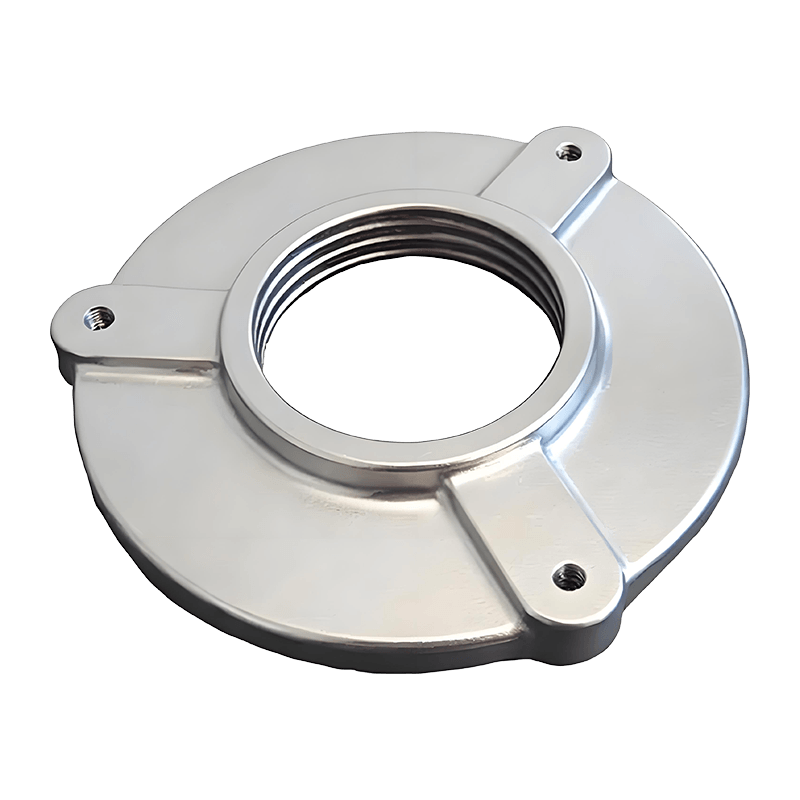
Die casting Fitness Part Flywheel
A flywheel is a rotating energy-storage component. When the user drives the exercise mechanism, the flywheel accelerates and stores kinetic energy. When the user’s input changes, the stored rotational energy helps maintain movement. This principle is especially important in indoor cycling equipment, rowing machines, elliptical trainers, and other products where smooth and controlled motion is essential.
The design of a flywheel affects several equipment characteristics. Its mass and distribution influence rotational inertia. Its outer profile can affect clearance and housing design. Its central bore and mounting geometry determine how it connects to a shaft, hub, belt, chain, clutch, or other transmission component. Its balance condition affects vibration and operating noise. Its surface finish and appearance influence the perceived quality of the finished fitness product.
For commercial gyms and institutional users, fitness equipment may operate for many hours each day. Residential users may also expect equipment to remain reliable for years with minimal maintenance. The flywheel therefore needs to withstand repeated acceleration, deceleration, vibration, and mechanical stress. A component that is only satisfactory during initial operation may create noise, uneven movement, premature wear, or service problems later.
These requirements make the manufacturing process as important as the nominal design. A flywheel with a sound drawing can still produce poor results if the mold is unstable, the alloy filling pattern is not controlled, machining references are inconsistent, or inspection is incomplete. Precision die casting addresses these risks by combining engineered tooling with a repeatable production cycle.
The die casting fitness part flywheel is an aluminum alloy component intended for use in exercise equipment and related mechanical systems. It can be developed according to the customer’s drawings, three-dimensional models, performance requirements, installation conditions, and production volume. The manufacturing approach is suitable for projects requiring a balance of lightweight construction, mechanical strength, accurate geometry, and attractive finishing.
Aluminum alloy is widely used in fitness equipment because it offers useful engineering properties. It provides a favorable strength-to-weight ratio, good castability, corrosion resistance, and compatibility with many finishing processes. Compared with heavier ferrous alternatives, an aluminum flywheel can help reduce overall equipment weight and simplify handling during assembly. At the same time, the design can be reinforced with ribs, webs, hubs, and carefully positioned material sections to support the required load path.
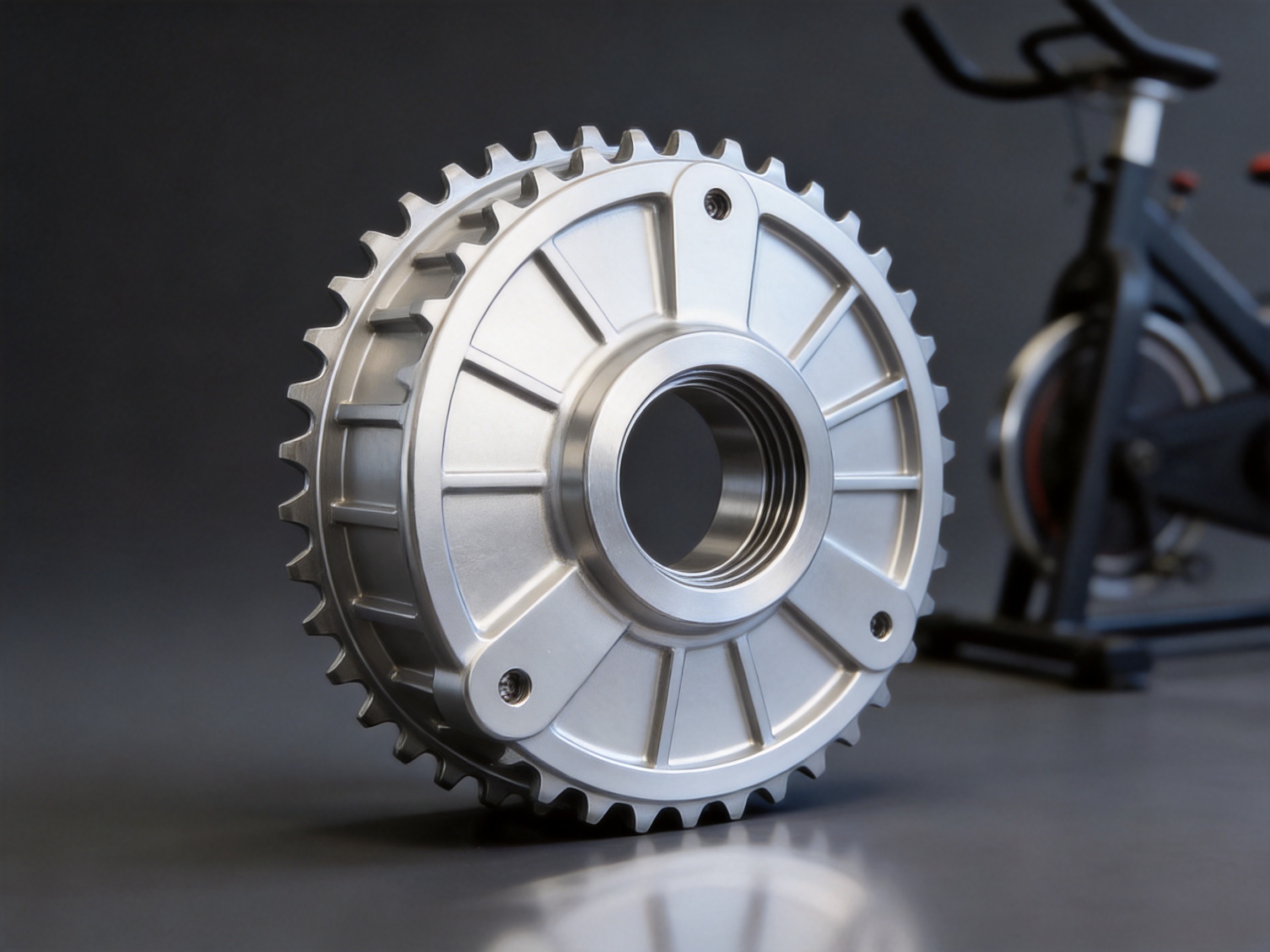
The product may be adapted to different equipment architectures. Depending on the application, the flywheel can include a central shaft opening, bolt holes, belt contact features, connection bosses, balancing provisions, or interfaces with a separate hub. The precise configuration should be determined through engineering review because the correct geometry depends on speed, drive method, target inertia, available space, assembly tolerances, and safety requirements.
The supplied product information also places the component within the broader category of die casting fitness equipment parts. This category may include handles, brackets, support pieces, covers, rotating elements, and other structural or functional components. The same manufacturing capabilities used for the flywheel can be applied to related parts, allowing equipment manufacturers to consolidate sourcing with one experienced die casting partner.
Balance is a fundamental requirement for any flywheel. An uneven mass distribution can create vibration as rotational speed increases. Excessive vibration may reduce user comfort, accelerate bearing wear, loosen fasteners, increase noise, and place additional stress on the frame. A well-designed casting, stable machining process, and appropriate balancing operation help support smooth rotation.
Balance requirements vary according to the operating speed, flywheel diameter, equipment structure, and application environment. A flywheel for a residential exercise bike may have different requirements from one used in a commercial training system. During product development, the customer and manufacturer can define the relevant balancing criteria and identify whether balancing is performed through machining, controlled material removal, added correction weights, or a combination of methods.
Dimensional accuracy affects installation, belt or chain alignment, shaft engagement, guard clearance, and the relationship between the flywheel and surrounding components. Critical dimensions must be identified before tooling begins. These may include the central bore, mounting face, bolt-circle location, axial thickness, outer diameter, flatness, runout, and the position of functional bosses.
Die casting provides a repeatable near-net-shape foundation, while machining can refine critical interfaces. This combination is more efficient than machining the entire component from a solid block, particularly when the flywheel includes a complex outer structure or a large volume of non-functional material that would otherwise be removed.
Fitness equipment components are subjected to repeated loading rather than a single static event. Each workout can involve thousands of cycles of acceleration, deceleration, belt tension, impact, and vibration. The flywheel must therefore be designed with suitable wall thickness, transitions, fillets, ribs, and connection areas. Avoiding abrupt changes in section thickness can help reduce casting defects and stress concentration.
Die casting parameters, alloy selection, mold temperature, filling behavior, and solidification conditions all influence the quality of the finished component. Engineering review and mold-flow analysis can help identify potential filling problems, air entrapment, shrinkage risks, and weak areas before the mold is manufactured.
Surface quality serves both functional and visual purposes. A smooth external surface can improve appearance and simplify cleaning. It can also provide a suitable foundation for powder coating, painting, anodizing, or other specified finishes. The appropriate finish depends on whether the flywheel is visible to the user, enclosed inside a protective housing, or exposed to a demanding environment.
Consistent mold preparation, controlled release, trimming, deburring, and finishing help reduce visible defects. If the customer has defined cosmetic zones, the inspection standard can distinguish between visible surfaces and non-visible areas. This approach helps control cost while preserving the appearance expected for the finished equipment.
One of the main advantages of die casting is the ability to produce a shape close to the final form. The mold can incorporate ribs, recesses, bosses, mounting features, and other details that would require multiple operations when produced by machining or fabrication. Fewer operations can reduce production time, material waste, and opportunities for dimensional variation.
For a flywheel, this advantage is particularly valuable because the component may combine a broad rotating body with a central mounting structure and reinforcing features. Die casting can form the main body efficiently while leaving only selected interfaces for precision machining. The process supports designs that would be expensive or impractical to manufacture entirely from billet or plate.
Once the mold, machine settings, trimming method, and inspection plan have been validated, die casting can produce large numbers of highly similar components. Repeatability is essential for fitness equipment manufacturers because consistent flywheel geometry supports standardized assembly. It also reduces the need for manual adjustment during production and helps maintain uniform user experience across different machines.
Production repeatability depends on more than the casting machine. Mold maintenance, process monitoring, material control, operator training, and inspection discipline are equally important. Dinghong’s integrated manufacturing structure combines these activities within a coordinated production system, helping reduce communication gaps between tooling, casting, machining, and quality-control teams.
Fitness equipment designers often need to combine attractive styling with functional performance. A flywheel may need a distinctive profile, decorative openings, reinforced spokes, hidden mounting details, or a protective outer contour. Die casting enables a wide range of shapes while maintaining a practical production route.
The design should still follow sound casting principles. Uniform transitions, suitable draft angles, appropriate radii, and accessible machining references support mold life and product consistency. Dinghong’s engineering team can review the proposed design and recommend adjustments before tool construction. Early design-for-manufacturing review is often more economical than correcting a problem after the mold has been completed.
Compared with subtractive manufacturing from a solid aluminum block, die casting can significantly reduce material removal. The mold forms much of the desired geometry directly, and the remaining machining is concentrated on functional areas. This can reduce scrap, shorten cycle time, and improve manufacturing efficiency.
Material efficiency is especially relevant for larger or heavier flywheels. While the finished part must contain sufficient mass and strength for its application, unnecessary material outside the intended load path increases cost and may make the equipment more difficult to handle. Engineering optimization can help achieve the required inertia without excessive material or overly complicated assembly.
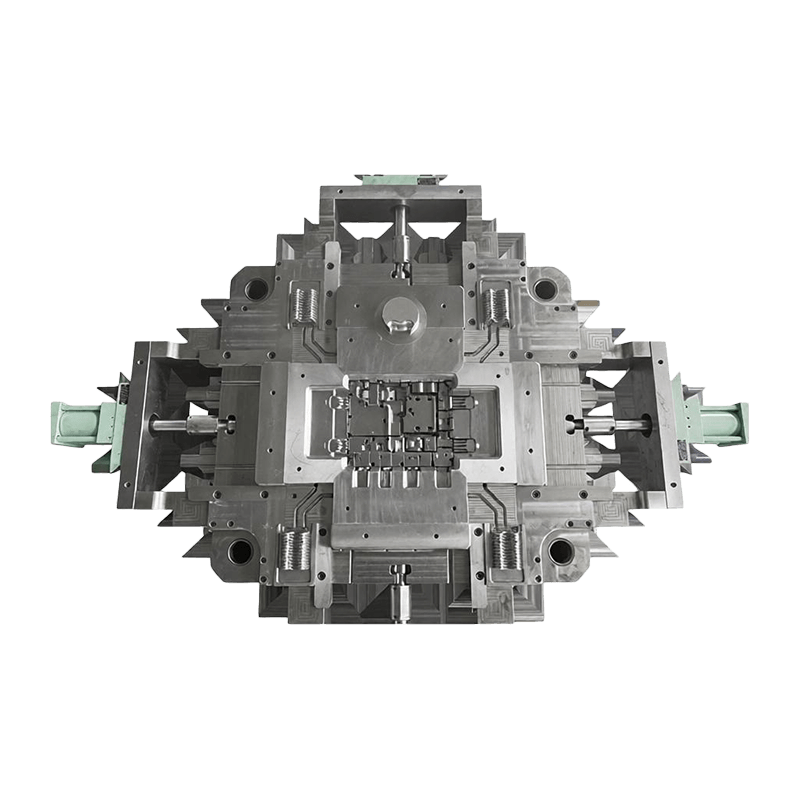
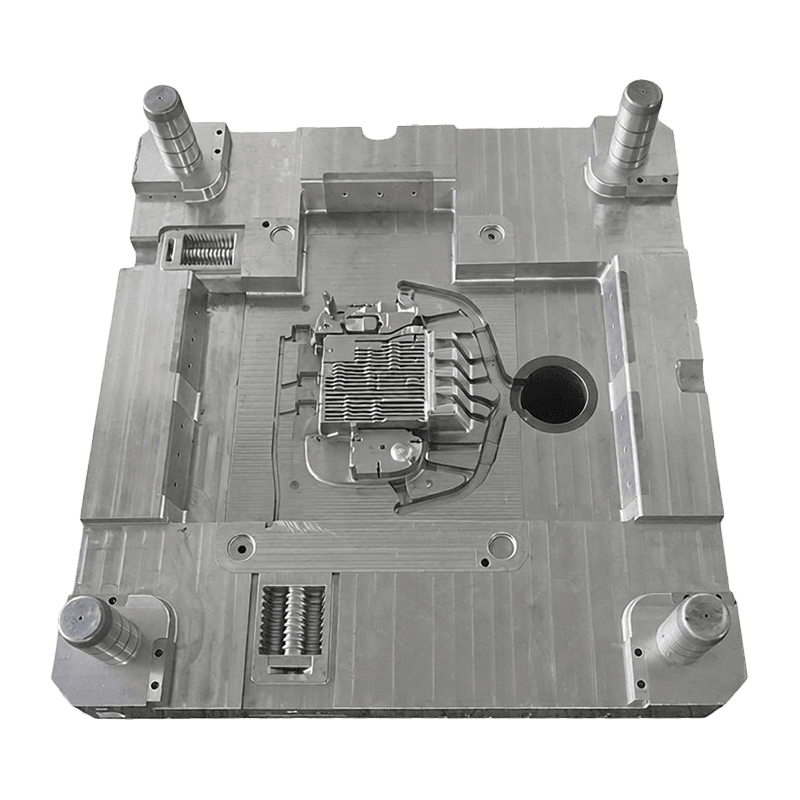
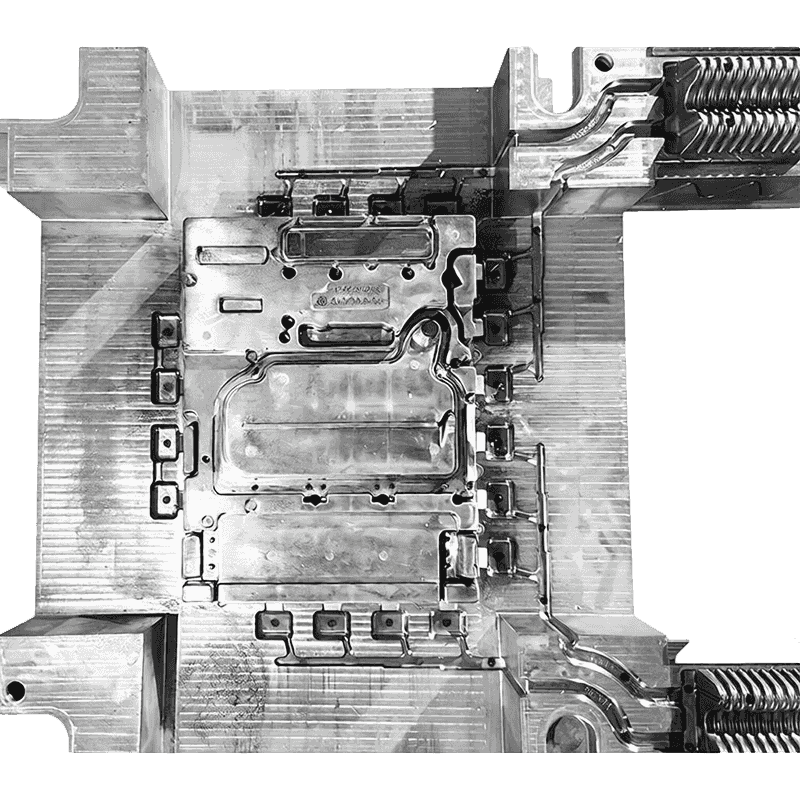
The quality of a die-cast flywheel begins with the mold. The mold determines how molten alloy enters the cavity, how air escapes, how the material solidifies, how the casting is ejected, and how the part is trimmed. A poor mold concept can create defects that no amount of later finishing can fully correct.
Dinghong provides mold design and mold manufacturing as part of its broader production capability. The company uses advanced design software and mold-flow analysis to examine the proposed part before manufacturing the tool. This digital review can help visualize filling behavior, identify potential air entrapment, evaluate solidification, and optimize gate, runner, overflow, and cooling arrangements.
Mold-flow analysis is not a substitute for engineering judgment, but it provides valuable information during development. It can support decisions about parting lines, gate locations, wall thickness, overflow positions, and cooling channels. By identifying risks earlier, the manufacturer can reduce the likelihood of expensive mold modifications and shorten the path to an approved production sample.
For a rotating fitness component, the mold design must also consider the relationship between cosmetic appearance and functional accuracy. The parting line should be placed where it can be managed during trimming and finishing. Ejector locations should avoid critical visible or machined surfaces whenever possible. The mold should support stable production over the anticipated tool life rather than focusing only on the first trial.
Tool steel selection, heat treatment, machining accuracy, surface preparation, and mold maintenance all influence the long-term performance of the die. High-precision CNC machining centers and EDM equipment allow complex mold details to be produced with controlled accuracy. After assembly, the mold is tested and refined to confirm that the casting can be removed reliably and that critical features remain stable from cycle to cycle.
Every project begins with a review of the customer’s drawings, three-dimensional data, target quantity, alloy requirements, surface finish, assembly conditions, inspection standards, and delivery expectations. The review should clarify the operating environment and identify which dimensions are critical to performance.
For a flywheel, the engineering team may need information about the drive system, shaft arrangement, expected speed range, target inertia, bearing arrangement, belt or chain tension, mounting method, and available clearance. This information helps ensure that the casting is not designed in isolation from the complete exercise machine.
After reviewing the product data, engineers evaluate wall thickness, draft, fillets, ribs, boss proportions, machining allowances, parting-line strategy, and ejection requirements. The goal is to preserve the customer’s functional design while making it suitable for efficient die casting.
Design-for-manufacturing recommendations may include modifying a sharp internal corner, adding a transition between thick and thin sections, adjusting a rib, relocating a non-critical feature, or improving access for machining. These changes are intended to improve reliability, not to alter the product’s essential function.
Once the design is confirmed, mold-flow analysis can be used to assess the proposed filling and solidification behavior. The mold is then manufactured using CNC machining, EDM, precision fitting, and inspection. The cavity and core surfaces are prepared according to the required appearance and dimensional standard.
Tool construction includes more than cutting the cavity. The manufacturer must also build the runner system, overflow areas, cooling arrangement, ejector system, guide components, inserts, and other supporting details. Each element contributes to cycle stability and product quality.
During die casting, molten aluminum alloy is injected into the closed mold under controlled conditions. The pressure and speed of injection help fill the cavity rapidly and reproduce the required details. After solidification, the mold opens and the casting is ejected for subsequent operations.
Process parameters are controlled according to the part design, alloy, machine capacity, and mold configuration. Important factors include material temperature, mold temperature, injection speed, pressure, filling time, cooling behavior, and cycle timing. Stable parameters help reduce variation in density, surface condition, dimensions, and internal integrity.
After casting, excess material such as gates, runners, overflows, and flash must be removed. Dinghong operates automated trimming lines and supporting equipment to improve efficiency and consistency. Automated or semi-automated trimming can reduce dependence on manual labor and help produce a more uniform edge condition.
Deburring is important for safe handling, assembly, and appearance. Sharp edges can damage belts, wiring, protective covers, or operators’ hands during assembly. The trimming method is selected according to the geometry and the areas that require later machining.
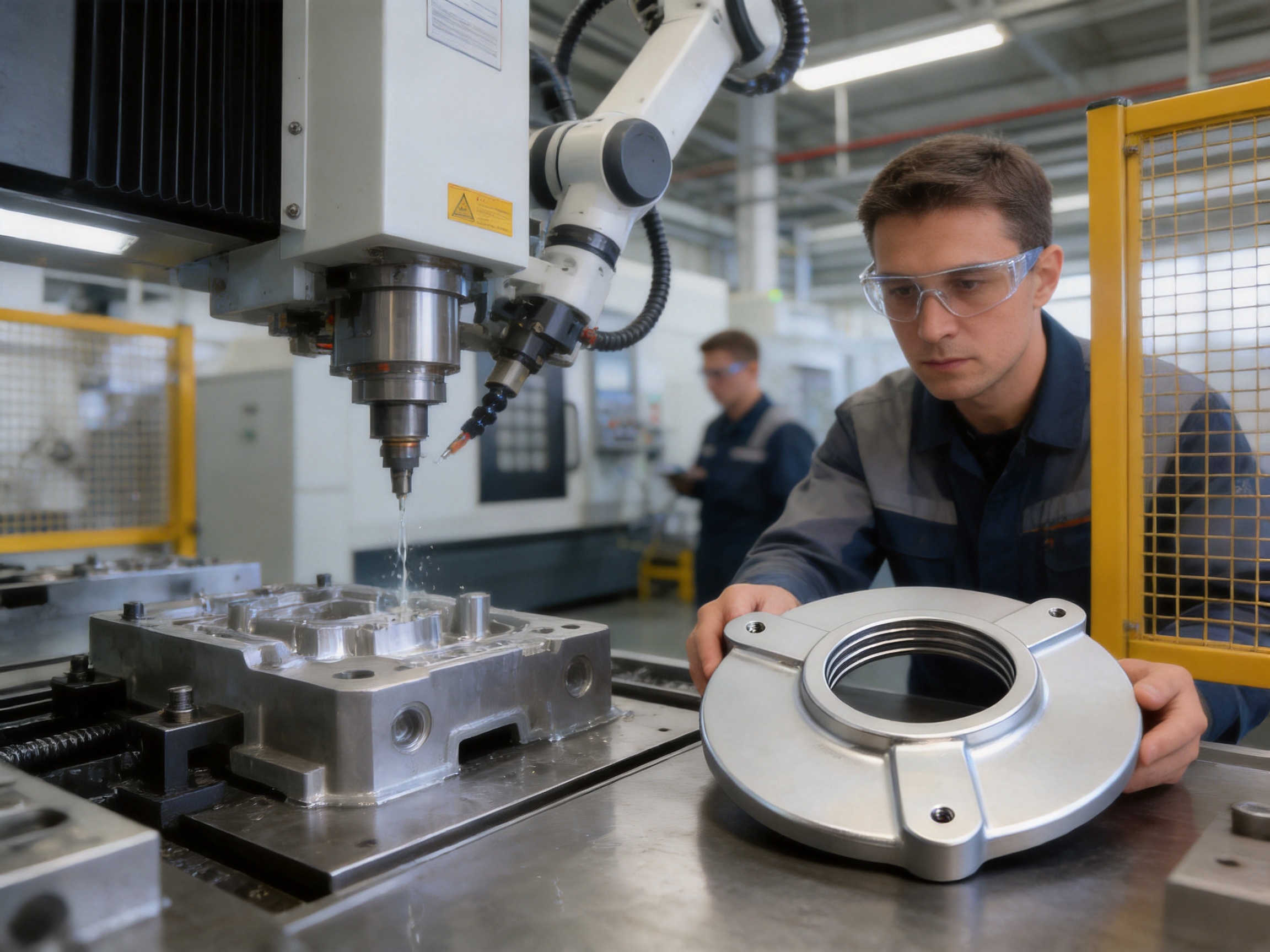
Critical interfaces can be machined after casting. Typical operations may include boring a central opening, machining a mounting face, drilling bolt holes, creating a shaft interface, or refining an alignment surface. CNC machining provides controlled accuracy and repeatable positioning.
Machining fixtures are developed around stable references. A well-designed fixture ensures that the casting is located consistently and that critical features maintain their relationship to the rotational axis. This is essential for controlling runout, concentricity, and alignment.
Depending on the customer’s design, the flywheel may receive cleaning, shot blasting, powder coating, painting, anodizing, or another specified finish. The selected process should be compatible with the alloy, dimensional tolerances, operating environment, and desired appearance.
Before finishing, the surface is prepared to remove contaminants and improve coating adhesion. Areas that must remain dimensionally precise can be masked or processed separately. Finished components are checked for coating coverage, adhesion, color consistency, visible defects, and protection of critical interfaces.
Inspection is performed throughout production rather than only at the end. Incoming material, mold trials, first articles, in-process castings, machined components, and finished products can all be evaluated according to the approved control plan. This layered approach helps detect variation early.
After final inspection, the flywheels are packed to protect machined surfaces, painted areas, and rotating edges during storage and transport. Packaging design may include separators, protective sleeves, foam, cartons, pallets, or customized arrangements based on shipment conditions and customer requirements.
Quality control for a die casting fitness flywheel should combine visual, dimensional, mechanical, and functional evaluation. The exact inspection plan depends on the product drawing and customer standard, but the following areas are commonly important.
| Inspection Area | Purpose | Typical Evaluation |
|---|---|---|
| Material control | Confirm that the correct aluminum alloy and production material are used | Supplier records, material identification, composition verification when required |
| Visual inspection | Identify surface and casting problems | Cracks, excessive porosity indications, cold shuts, flash, dents, stains, and coating defects |
| Dimensional inspection | Confirm that the component fits and functions correctly | Diameter, thickness, bore, hole position, height, flatness, and other drawing dimensions |
| Geometric inspection | Control the relationship between functional features | Concentricity, perpendicularity, parallelism, position, and runout |
| Balance evaluation | Support smooth rotation during equipment operation | Static or dynamic balance according to defined application requirements |
| Surface-finish inspection | Verify appearance and coating performance | Color, gloss, coverage, adhesion, cleanliness, and cosmetic acceptance zones |
| Process inspection | Maintain stable production conditions | Parameter records, first-piece approval, sampling plans, and traceability |
Dinghong has ISO 9001 and IATF 16949 quality management system certifications. These certifications reflect the company’s structured approach to process control, documentation, corrective action, and continual improvement. Certification does not replace product-specific requirements, but it provides a management framework for controlling them consistently.
For automotive and other demanding industries, IATF-oriented practices encourage disciplined risk analysis, traceability, process capability evaluation, and systematic problem solving. These practices can also benefit fitness equipment projects, particularly when a customer requires stable supply across multiple production years or needs documented quality records for international distribution.
Sand casting can be useful for low-volume or very large components, but its surface finish and dimensional consistency may not be ideal for a precision fitness flywheel. Die casting generally provides a smoother surface, closer repeatability, and better suitability for higher-volume production. It also supports thinner and more detailed features when the design and alloy are appropriate.
Machining a flywheel from solid aluminum can provide flexibility during prototyping, but it may involve substantial material removal, long cycle times, and high tooling or labor costs for repeated production. Die casting forms the main body efficiently and reserves machining for the features that truly require high precision. For medium- and high-volume programs, this can provide a more competitive total manufacturing cost.
A fabricated flywheel made from several separate pieces may require welding, riveting, bolting, or adhesive bonding. Each additional joint introduces potential variation, extra assembly time, and another area that must be inspected. A die-cast body can integrate multiple structural features into one component, reducing the number of parts and simplifying assembly.
Engineering plastics can be suitable for selected fitness equipment applications, especially where low weight and electrical insulation are important. However, an aluminum alloy flywheel can provide a different combination of rigidity, heat dissipation, dimensional stability, and premium appearance. The correct material depends on the required inertia, speed, loading, cost target, and equipment architecture.
The flywheel offers manufacturers a practical balance between performance and manufacturability. Its aluminum alloy construction can help reduce unnecessary equipment weight while preserving a strong and stable rotating structure. Its die-cast geometry can accommodate functional features that support direct integration with the machine’s transmission and frame.
Another important advantage is supply consistency. Fitness equipment manufacturers often sell the same model across different markets and production periods. A repeatable die casting process helps maintain consistent dimensions and appearance, reducing assembly adjustments and customer complaints. Stable sourcing is particularly valuable when a component is used in several equipment models.
The product can also be customized. Customers may provide a drawing, a three-dimensional file, a physical sample, or an initial concept. The engineering team can help transform that information into a manufacturable mold design. Customization may include the outer profile, central opening, mounting holes, rib layout, surface finish, logo area, balancing method, and packaging arrangement.
Because Ningbo Dinghong Mould Co., Ltd. provides mold design, mold manufacturing, casting, finishing, and trade services, customers can coordinate multiple project stages through one supplier. This integrated structure can reduce the risk of inconsistent technical communication between separate mold makers, foundries, machining companies, and finishing vendors.
Ningbo Dinghong Mould Co., Ltd. was established in 2013, following the establishment of Yuejin Mould in 1998. The company is located in Daqi Street, Beilun District, Ningbo, Zhejiang Province, near Beilun Port. Its location supports convenient access to industrial supply chains, transportation infrastructure, and international shipping services.
The company occupies approximately 15,000 square meters of plant space and has developed from a smaller factory into a modern manufacturing enterprise. Its production scope includes mold design, mold manufacturing, die casting, finishing, and trade. This range allows the company to manage a complete manufacturing sequence rather than focusing on only one isolated operation.
Dinghong’s equipment includes high-precision CNC machining centers, EDM equipment, die casting machines, automated trimming lines, and testing equipment. CNC machining supports accurate mold and product work. EDM equipment helps produce complex mold details. Die casting machines provide the pressure and production capacity needed for aluminum alloy components. Automated trimming supports consistent post-casting processing.
The company serves several industries, including automotive, new energy, photovoltaic, telecommunications, electrical products, motorcycles, pumps and valves, fitness equipment, robotics, and other applications. Experience across these sectors can strengthen engineering discipline because the company must manage different performance requirements, documentation standards, appearance expectations, and production volumes.
Dinghong’s sales network covers China, South America, Southeast Asia, and other international markets. Its international experience supports communication with customers that have different technical standards, packaging expectations, inspection procedures, and delivery arrangements. The company also plans to expand into Europe and other regions, reflecting its interest in serving a broader global customer base.
Customers considering a custom flywheel should provide as much technical information as possible at the beginning of the project. Useful information includes the product drawing, three-dimensional model, material preference, annual demand, estimated order quantity, operating speed, target inertia, installation method, surface finish, critical tolerances, inspection requirements, and packaging instructions.
If the final design is not complete, the customer can share the available concept, sample, or equipment interface. Dinghong’s technical team can then review the design and identify the information needed to proceed. Early communication helps prevent delays related to unclear dimensions, missing tolerances, unsuitable wall thickness, or incomplete finishing requirements.
Prototype and sample approval are important stages. The first samples can be used to evaluate fit, rotation, balance, appearance, assembly time, and compatibility with the complete machine. If improvements are required, the engineering team can adjust the mold, machining program, fixture, or finishing process before mass production begins.
For ongoing production, a control plan can define inspection frequency, critical characteristics, sampling methods, reaction procedures, and record retention. The production team can also maintain traceability for material batches, mold versions, process changes, and inspection results. These practices support stable supply and make future technical analysis more efficient.
Indoor cycling bikes depend on a smooth and responsive rotating system. The flywheel must work with the drive belt, crank assembly, resistance mechanism, and protective housing. Its balance, concentricity, and surface quality are particularly important because users can easily feel vibration or irregular resistance during pedaling.
Rowing equipment may use a rotating flywheel to create air resistance or to support another resistance system. The flywheel interacts with a belt, chain, handle mechanism, and fan or resistance housing. The component must operate reliably through repeated acceleration and deceleration while maintaining alignment with the surrounding structure.
Elliptical trainers contain multiple rotating and linkage components. A flywheel can contribute to smooth pedal movement and controlled resistance. The available installation space may be limited, so the casting may need a compact profile with integrated mounting and reinforcing features.
Some multi-function training systems use rotating components to regulate resistance, store energy, or transfer motion. These systems may require custom geometry and close coordination between the flywheel, frame, cable mechanism, bearings, and control system. Die casting provides the design flexibility needed for specialized equipment.
Rehabilitation equipment and professional training systems often emphasize smooth movement, controlled resistance, low noise, and long service life. A precision-produced flywheel can support these objectives when integrated with appropriate bearings, drive components, guards, and control mechanisms.
The design should avoid unnecessary abrupt changes in wall thickness. Sudden transitions can affect filling and solidification and may create areas of increased stress. Gradual transitions, suitable radii, and well-proportioned ribs generally support more stable casting behavior.
Critical bearing, shaft, and mounting interfaces should be clearly identified. These areas may require machining allowances and controlled references. The design should distinguish between surfaces that require tight tolerances and surfaces where standard casting tolerances are sufficient. This distinction helps control cost without compromising function.
Draft should be included on mold-release surfaces. Adequate draft reduces the force required to eject the casting and helps protect both the mold and the product. The appropriate amount depends on the surface condition, depth, texture, alloy, and customer appearance requirements.
Ribs can improve stiffness without requiring a solid, excessively thick section. However, ribs should be designed with suitable thickness and connection transitions. Oversized ribs may create local thermal differences or unnecessary weight. The best arrangement is determined by the load path, casting behavior, and target inertia.
Clearance should be checked against the complete assembly. The flywheel may rotate near a guard, belt, sensor, frame, or wiring route. Dimensional variation, coating thickness, bearing play, and assembly tolerance should be included in the clearance analysis. Early digital interference checks can prevent costly changes later.
Branding, identification marks, and date or batch codes can sometimes be incorporated into the mold. These details should be positioned where they do not interfere with balance, machining, assembly, or cosmetic requirements. Permanent identification can support traceability and service management when appropriate.
A flywheel is not an isolated casting. Its performance depends on the relationship between mold design, alloy behavior, trimming, machining, balancing, finishing, assembly, and final equipment testing. If each activity is managed by a separate supplier with limited communication, the project may experience delays or inconsistent results.
Integrated manufacturing creates a clearer feedback loop. The mold engineer can communicate directly with the casting team. The machining team can report whether a casting feature is easy to fixture. The quality team can identify recurring dimensional variation. The finishing team can advise on surface preparation. This cooperation allows problems to be addressed closer to their source.
Dinghong’s combination of mold production, die casting, finishing, and trade services supports this type of coordination. The company can manage the project from early engineering review through finished product delivery, while customers retain the ability to define their own drawings, inspection standards, and approval procedures.
Manufacturing cost is influenced by tooling investment, material consumption, cycle time, machining requirements, finishing, inspection, packaging, logistics, and order volume. Die casting may require a higher initial mold investment than some low-volume methods, but the tooling cost can be distributed across repeated production quantities. As volume increases, the efficient cycle and reduced machining content can improve the overall unit cost.
Aluminum alloy can also support practical material management. Scrap generated during production may be collected and managed according to the applicable material-control procedure. Efficient mold design, controlled shot weight, and reduced machining allowance can help limit unnecessary waste. Environmental performance should be evaluated across the complete manufacturing process rather than based on one operation alone.
Long product life is another important consideration. A flywheel that remains dimensionally stable and mechanically reliable can reduce replacement frequency, service visits, and equipment downtime. For commercial fitness operators, these indirect costs can be significant. A durable component therefore provides value beyond its initial purchase price.
Before approving a flywheel for production, customers should define which dimensions affect assembly and operation. They should also specify the acceptable level of cosmetic variation, the required surface finish, the balancing standard, and the documentation needed for each shipment.
It is useful to distinguish between critical, major, and minor characteristics. Critical characteristics may include the rotational axis, bore, mounting pattern, runout, and balance. Major characteristics may include outer diameter, thickness, visible surface condition, and guard clearance. Minor characteristics may include non-functional marks in concealed areas. A clear classification helps the supplier focus inspection resources appropriately.
Customers should also decide whether they require first-article inspection, material reports, dimensional reports, process capability information, sample retention, or periodic requalification. These requirements are especially important when the flywheel is used in several models or supplied to multiple markets.
It is used as a rotating energy-storage and motion-support component in fitness equipment such as indoor cycling bikes, rowing machines, elliptical trainers, resistance systems, and other exercise devices. The exact function depends on the equipment’s drive and resistance architecture.
Aluminum alloy offers a useful combination of castability, strength-to-weight ratio, corrosion resistance, and finishing compatibility. It can be formed into complex geometries while keeping the finished equipment more manageable than a comparable component made from a heavier material.
Yes. The outer profile, central interface, mounting details, ribs, bosses, surface finish, balancing provisions, identification marks, and packaging can be developed according to the customer’s drawing and equipment requirements. Customization should be reviewed through design-for-manufacturing analysis before mold construction.
Customers should provide drawings or three-dimensional data, material requirements, estimated annual quantity, initial order quantity, surface finish, critical tolerances, application information, inspection requirements, and delivery expectations. Information about speed, drive method, target inertia, and mounting conditions is also helpful for engineering evaluation.
Mold-flow analysis helps evaluate how molten alloy may fill and solidify within the cavity. It can reveal potential filling difficulties, air entrapment, shrinkage risks, and thermal differences. This information supports decisions about gates, runners, overflows, cooling, wall thickness, and parting lines before the mold is built.
Features requiring close dimensional control often receive secondary machining. These may include a central bore, shaft interface, mounting face, bolt holes, alignment surfaces, and selected balancing areas. The exact operations depend on the casting design and the customer’s tolerance requirements.
Balance is supported through stable casting geometry, accurate machining references, control of critical dimensions, and a defined balancing operation when required. The appropriate method may involve static or dynamic balancing, controlled material removal, or another approved correction process.
Ningbo Dinghong Mould Co., Ltd. provides mold design, mold manufacturing, die casting, finishing, and trade services. This integrated capability allows customers to coordinate tooling and finished-part production through one manufacturing partner.
The company has ISO 9001 and IATF 16949 quality management system certifications. These systems support structured quality planning, process control, documentation, corrective action, and continual improvement.
The die casting process is intended to produce strong and stable components for repeated use. Final suitability depends on the approved design, alloy, operating speed, loading conditions, safety factors, assembly, and equipment-level testing. Customers should validate the flywheel in the complete fitness machine before release.
Yes. The company’s broader capabilities cover die casting fitness equipment parts, including components such as handles, brackets, support pieces, housings, and other aluminum alloy products. Related components can be evaluated individually according to their functional and cosmetic requirements.
The die casting fitness part flywheel is a practical solution for exercise equipment manufacturers seeking smooth rotation, reliable mechanical performance, consistent production, and efficient integration. Its aluminum alloy construction can support a favorable balance of strength, weight, appearance, and manufacturability. Precision die casting forms the main geometry efficiently, while CNC machining and finishing refine the interfaces and appearance that matter most.
The strongest results come from treating the flywheel as part of a complete engineering and manufacturing system. Mold-flow analysis, design-for-manufacturing review, stable die casting, automated trimming, accurate machining, appropriate finishing, balance control, and documented inspection all contribute to the final product. These steps help reduce variation and support dependable operation in equipment used repeatedly by residential, commercial, rehabilitation, and professional customers.
Ningbo Dinghong Mould Co., Ltd. combines mold development, die casting, machining, finishing, inspection, and international trade support. Its experience in automotive, appliance, telecommunication, fitness, robotic, new-energy, and other industries provides a broad technical foundation for custom aluminum alloy components. With ISO 9001 and IATF 16949 certifications, advanced production equipment, mold-flow analysis, and an integrated manufacturing structure, the company is positioned to support customers from initial concept through stable mass production.
For manufacturers developing a new fitness machine or improving an existing model, the flywheel should be evaluated not only by purchase price but also by balance, durability, assembly efficiency, supply consistency, service life, and total manufacturing value. A properly engineered die-cast component can contribute to smoother equipment operation, stronger product differentiation, and a more reliable user experience over the life of the machine.
1. ISO 9001, Quality Management Systems — Requirements.
2. IATF 16949, Quality Management System Requirements for Automotive Production and Relevant Service Parts Organizations.
3. NADCA Product Specification Standards for Die Castings.
4. ASM Handbook, Volume 15: Casting.
5. ASM Handbook, Volume 2: Properties and Selection of Nonferrous Alloys and Special-Purpose Materials.
6. Aluminum Association, Aluminum Standards and Data.
7. International Organization for Standardization, Geometrical Product Specifications and Verification Standards.
8. Industrial die casting process-control and mold-design practices for aluminum alloy components.

Materials & Manufacturing Yes, Aluminum Die Casting Parts are consistently lighter than Cast Iron Parts when engin...
READ MOREDie casting automotive parts are made by forcing molten metal into a steel mold under high pressure, where it fills t...
READ MOREBefore a part ever reaches production, every buyer eventually asks the same question: should this component be injectio...
READ MORETwo quotations for the same aluminum controller housing can differ by 20% or more, even when both suppliers list the sa...
READ MORE

Sun Yuejun: +86-13806631860
Wang Shiyong: +86-15958891460 / 15058297768
Dove Yao: +86-18625086675


Copyright © Ningbo Dinghong Mould Co., Ltd. Rights Reserved. Custom Precision Die Casting Aluminum Alloy Parts Manufacturers
